
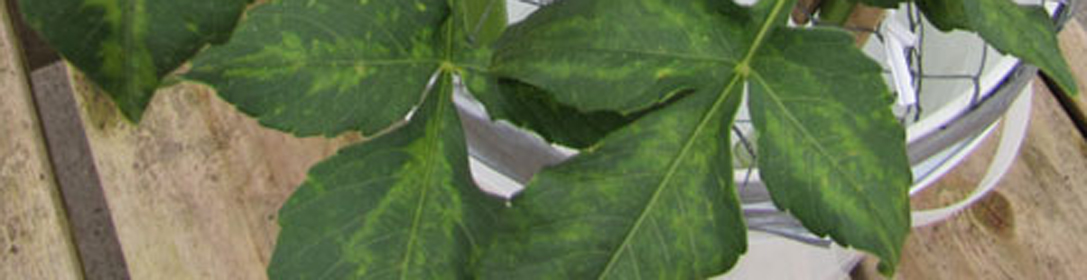
Our ability to detect and to control viruses in our dahlia gardens has improved dramatically over the last 20 years. Washington State University (WSU) has been at the heart of the research work that has made that progress possible. The American Dahlia Society has also been an integral part of the work at WSU throughout that period. In 2017, the Scheetz-Chuey Charitable Foundation made it possible to sponsor a permanent Chair for Dahlia Research and Development at WSU and to create a Dahlia Resource Center there. These investments are providing the bases for a rapid increase in our understanding of dahlia viruses and of the best ways to control virus in our gardens.
An ADS Virus Team has been working with WSU to coordinate virus testing in member dahlia gardens and in communicating test results and control techniques to our dahlia growers. With the cooperation of Professor Pappu at WSU and with the financial support from the Scheetz-Chuey Foundation, the testing of field dahlia plants started in 2015 and that work grew in volume, importance, and effectiveness through the 2023 growing season. At that point, the results showed that Dahlia Mosaic Virus (DMV) was the dominant virus in most of our gardens and the focus of the work shifted to the factors that control that virus.
Perhaps the key question in 2024 and 2025 was whether or not the techniques required to control DMV were different from the techniques that were shown to be effective in controlling the RNA viruses: TSV, TSWV, INSV, and CMV. The good news is that, with essential help from a small group of home and commercial gardeners, we were able to show that the procedures that work for the RNA viruses also work for DMV! Those results are being prepared, at this writing, for publication in the April, 2026 ADS Bulletin.
The bottom line of that upcoming publication is the generation of an action plan that will substantially improve dahlia health and reduce virus spread. That strategy is as follows:
Key Strategies for Improving Dahlia Health
A small set of consistent management practices can substantially improve dahlia health and reduce virus spread.
Risk-Based Separation
Assign dahlias to distinct planting areas based on their likelihood of infection. Symptomatic plants and unobserved new stock carry the highest risk. Asymptomatic, untested plants are at moderate risk. First-year seedlings and tested plants that remain asymptomatic have the lowest risk. Maintain as much physical separation between these groups as possible.
Sanitation
Always disinfect tools between plants while working in the garden. Rotating and immersing blades in a 10% bleach solution for at least one minute between plants reduces mechanical virus transmission.
Pest Management
Implement early, consistent aphid and thrip control strategies to reduce virus transmission by insect vectors.
Symptom Monitoring
Become familiar with common virus symptoms, including yellowing veins, necrotic spotting, slow growth, weak stems, and short internodes. Remove symptomatic plants from low- or moderate-risk beds promptly.
Low-Risk Stock Development
Start dahlias from seed, which is the most economical beginning to virus-free plants. Seek new stock from growers who offer virus-tested dahlias or follow practices that minimize disease transmission. Propagate dahlias from plants in your low-risk group.
These steps, when used consistently and year-over-year, have been shown to markedly improve dahlia health.
(Strategy summary developed from “Growing Healthier Dahlias: Lessons from Pioneering Growers,” by Janell Weiss, LeeAnn Huber, Beckie Curtis and Ron Miner, ADS Bulletin, April, 2026.)
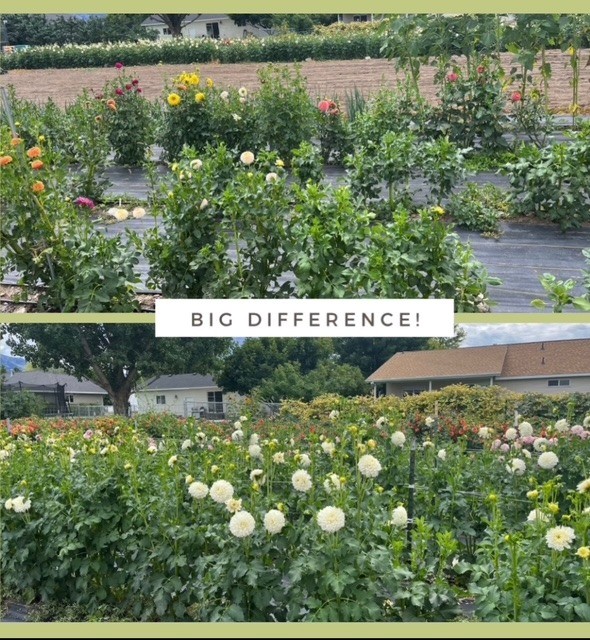
Photo, Stonehouse Dahlias
WSU Dahlia Resource Center
Prof. Hanu Pappu’s team has focused on resolving long-standing taxonomic questions about Dahlia mosaic virus (DMV) and Dahlia common mosaic virus (DCMV). From infected dahlia leaf samples collected across the United States, Dr. Prabu has obtained the complete genomic sequences of several DMV and DCMV isolates. This work is recently published in the peer-reviewed journal, Archives of Virology, under the title: “Genomic sequence of dahlia mosaic virus revisited: Molecular characterization and genetic diversity of DMV and dahlia common mosaic virus.”
The Dahlia Resource Center has established a Foundation Block of virus-free stock of popular dahlia cultivars. Dr. Prabu has successfully established a meristem-tip culture based virus-elimination pipeline. Several cultivars, identified and provided by the ADS Virus Team members, have already been cleaned through this process. Virus-free plants are now being propagated and prepared with the goal to scale up the production of rooted cuttings in pots and tubers.
Plans are in preparation to work with Professor Alex Harkess to improve our understanding of virus resistance based on the new knowledge available in the dahlia genome.
Donate
If you are interested in helping the ADS fund this project, give your gift today. Please indicate on your check or donation that you would like to fund the WSU Virus project. Please show your support and give a gift. Send your donation to:
ADS/WSU Virus Project
38430 Piggott Bottom Road
Hamilton, VA 20158
or donate online: