|
|
ADS Classification and Handbook of Dahlias
|
Glossary of Terms
- BLEND
- Two or more evenly merging harmonious or pleasingly contrasting colors.
- CENTRAL RAYS
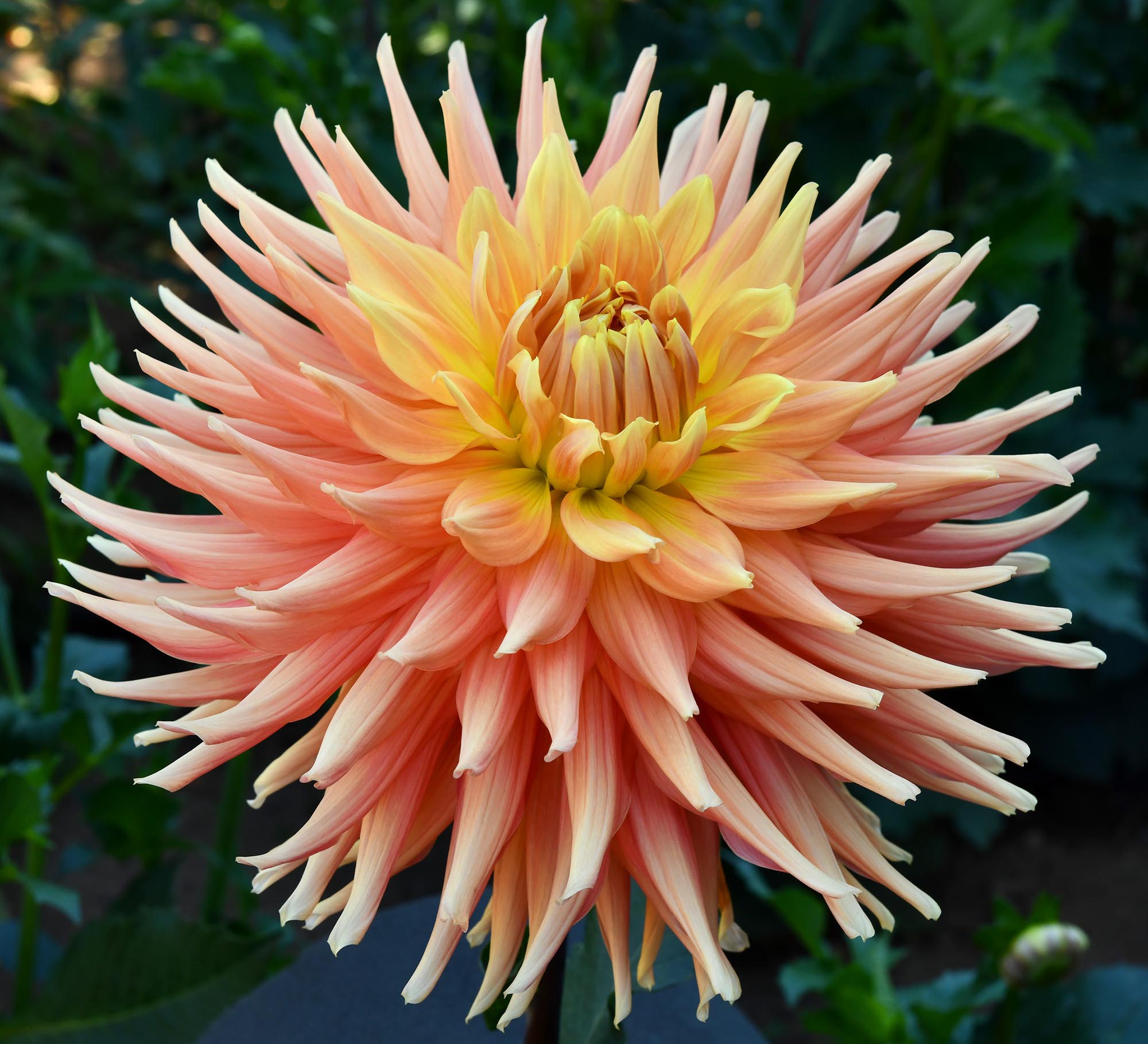
- The short or immature ray florets comprising the central portion of the fully double flowers when at their prime stage.
- DISC
- A more or less flat, circular group of tubular florets fully visible in open-centered type dahlias.
- DISC FLORETS
- Small tubular florets which make up the central part of the flower head, each with a pistil and stamens but generally no other conspicuous flower parts.
- DWARF
- Dahlia varieties that normally do not produce plant growth over 24 inches in height.
- FLORET
- One of the small flowers that collectively comprise the flower head.
- FULLY DOUBLE
- Flower heads with multiple rows of ray florets; the disc florets are immature and completely covered by the central rays when a bloom is at the prime stage.
- INCURVED
- The ray florets curve forward along their length toward the face of the flower head.
- INVOLUTE
- Margins of the ray florets roll forward along their longitudinal axis (length). When fully involute the margins touch or overlap so only the reverse of the floret is visible.
- LACINIATED
- The ray florets are split; there should be a twisting in the area of the split involute or revolute ray florets, to give an overall fringed effect.
- MARGIN
- The edge of the ray floret, sometimes marked with a narrow contrasting color
- MARGINAL RAYS
- : Fully developed ray florets that establish and determine the maximum diameter of a bloom; mature florets rather than immature central ray florets.
- PETAL
- The common name for the conspicuously colored part of a ray floret.
- PETALOIDS
- Additional floral parts on ray florets having the form and appearance of smaller petals. Most noticeable in the collarette dahlias.
- RAY FLORET
- One of the broad, conspicuously colored florets, the structure of which suggests a single petal of an ordinary bloom. These form the radiating border in the open-centered type dahlias, or massed together, the flower head in fully double types.
- RECURVED
- The ray florets curve backward along their length toward the stem.
- REFLEXED
- A straight ray floret from the tip to the base that extends and drops toward the stem.
- REVOLUTE
- Margins of the ray florets roll backward along their longitudinal axis. When fully revolute, the margins touch or overlap.
- STRAIGHT
- The ray florets have little or no curvature throughout their length.
Copyright © 1995
- present, American Dahlia Society, all rights reserved.