|
|
Back to home page of
|
|
|
Back to home page of
|
|
Code |
Description |
|
Anemone-flowered |
|
|
Ball |
|
|
Straight Cactus |
|
|
Collarette |
|
|
Formal Decorative |
|
|
Incurved Cactus |
|
|
Informal Decorative |
|
|
Laciniated |
|
|
Micro Anemone-flowered |
|
|
Micro Collarette |
|
|
Micro Novelty Open |
|
|
Micro Novelty Fully Double |
|
|
Micro Orchid-flowering |
|
|
Micro Orchette |
|
|
Micro Peony-flowering |
|
|
Micro Stellar |
|
|
Micro Water Lily |
|
|
Miniature Ball |
|
|
Mignon Single |
|
|
Novelty Open |
|
|
Novelty Fully Double |
|
|
Orchid-flowering |
|
|
Orchette |
|
|
Pompon |
|
|
Peony-flowering |
|
|
Single |
|
|
Semi-Cactus |
|
|
Stellar |
|
|
Water Lily |
All dahlias in classes 0001 through 7715: Formal Decorative, Informal Decorative, Semi-Cactus, Cactus, Incurved Cactus, Laciniated, Ball, Miniature Ball, Pompon, Stellar, Waterlily and Novelty Double are fully double with the central rays spirally displayed. The mature petals that determine the size of the dahlia determine the dahlia formation. In the following descriptions, the X in the number range signifies size and can be replaced with 0 (AA), 1 (A), 2 (B), 3 (BB), 4 (M) or 5 (MC).
X001—X015 FORMAL DECORATIVE Dahlias: Ray florets are generally flat, broad, and smooth in a regular arrangement that gradually recurve toward the stem. Each ray floret row should convey uniform and regular size arrangement with the tips preferably round or extending to a slight point. The ideal depth is three-quarters the diameter of the bloom and should not be greater than its diameter.
X101—X115 INFORMAL DECORATIVE Dahlias: Ray florets are twisted, curled, or wavy, and of uniform size in irregular arrangement. They may be partially involute or revolute, but no portion should be fully revolute or involute except at the tip of the ray floret. The ideal depth is three-quarters the diameter of the bloom and should not be greater than its diameter.
X201—X215 SEMI-CACTUS Dahlias: Ray florets are broad at the base, straight or incurved, and reflex toward the stem in a regular and uniform arrangement. Ray florets will be revolute for approximately half their length and fully revolute (touching or overlapping) for at least one-fourth their length. The ideal depth is three-quarters the diameter of the bloom and should not be greater than its diameter.
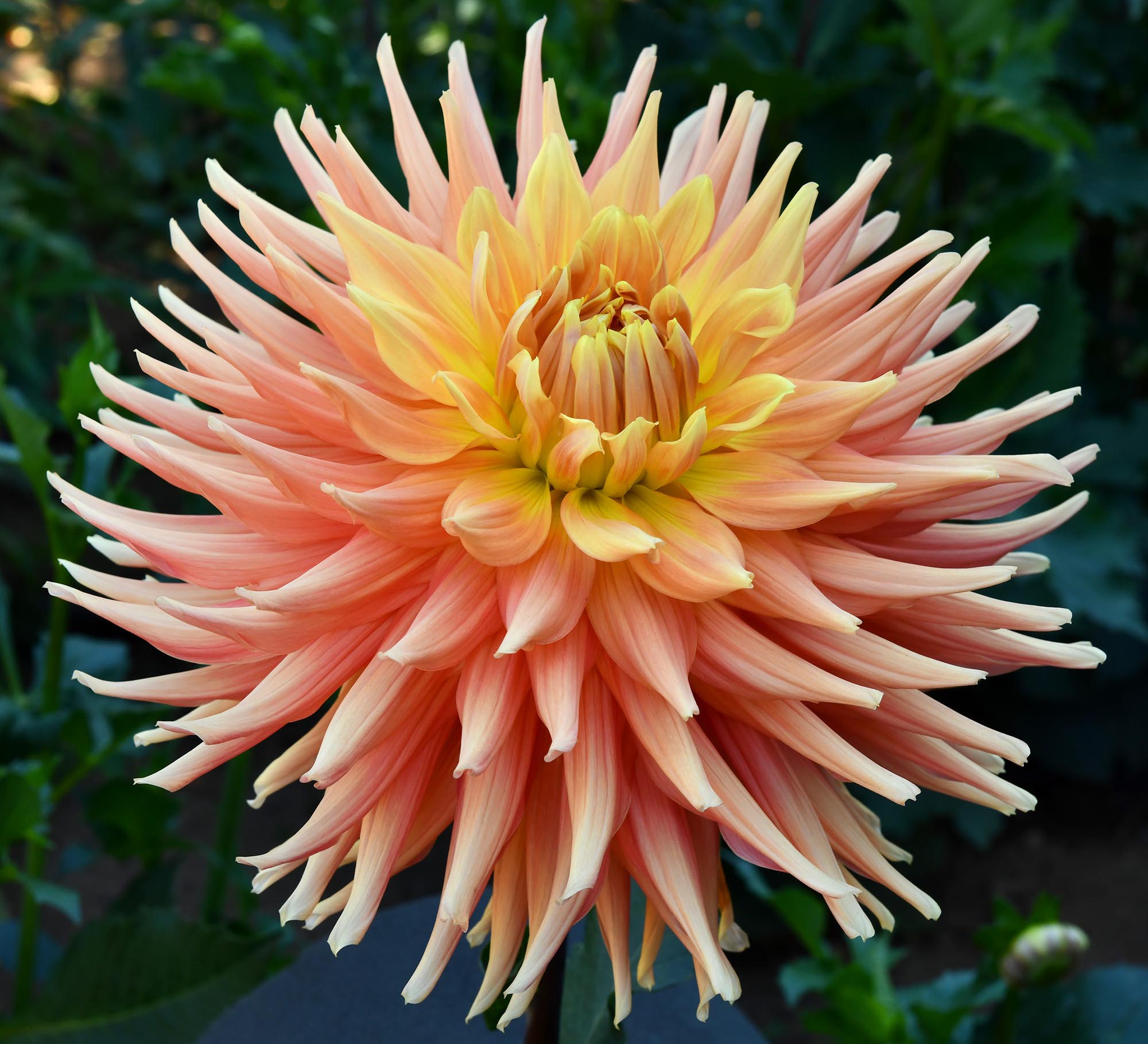
X301—X315 STRAIGHT CACTUS Dahlias. Ray florets are narrow at the base, straight, uniform in length and reflex toward the stem, radiating uniformly in all directions from the center. They will be revolute for the majority of their length and fully revolute (touching or overlapping) for approximately half their length. A depth of about three-quarters the diameter is ideal for this form.
X401—X415 INCURVED CACTUS Dahlias: Ray florets are pointed, narrow at the base, uniform in length and arrangement, revolute for the majority of their length, and fully revolute for at least half their length. They will curve upward to the bloom face, but may also arc downward and then up, or they will swirl horizontally around the bloom circumference, usually exposing the involucre in either case. Depth must be at least half the diameter.
X501—X515 LACINIATED Dahlias: Ray florets are split at the tip with the number and depth of the splits varying according to the size of the ray floret. The portion of the ray floret with the splits should uniformly twist or curl whether involute or revolute. The less mature ray florets should possess splits but do not have to twist or curl. In the ideal laciniated dahlia, the majority of ray florets will be uniformly arranged with a split, twist, or curl that conveys an overall fringed or frilled effect. Ray florets, slightly involute or revolute, that split regardless of length and remain generally flat are a major fault. Ray florets with a shallow notch or cleft and possessing little twisting to the extreme portion should not be classified as laciniated. The ideal depth is three-quarters the diameter of the bloom and should never be greater than its diameter.
6001—6015 BALL Dahlias: Blooms are ball shaped with uniform florets, involute for most of their length, and fully involute for more than half the length; the ray florets reflex toward the stem. Ray floret tips in cross-section should be circular and exhibit little distortion, completely filling the floral head and are either round or blunt without notch or point.
6101—6115 MINIATURE BALL Dahlias: Except for size, miniature ball and ball dahlias possess the same form features.
6201—6215 POMPON Dahlias: The ray florets are involute for the whole of their length and fully involute for half their length. Except for size they are similar to the ball description.
7001—7015 STELLAR Dahlias: Ray florets are long and narrow along their length with pointed tips preferred; like a star, they exhibit space between the ray florets in each of the rows and possess a uniform, regular arrangement. All the ray florets will have a partially involute form in an approximate U shape in cross-section for the majority of their length and will recurve toward the stem; the bloom depth should be greater than one half of the diameter and should not be greater than its diameter.
7101—7115 MICRO STELLAR Dahlias: Micro Stellar dahlias posses the same formation as Stellar dahlias except they are under 2 inches in diameter.
7301—7315 WATERLILY Dahlias: The bloom should be fully double and symmetrical; the side view should be flat to saucer-shaped in arrangement, and the layer of florets should be open faced to give a delicate appearance. The center should be closed and dome-shaped breaking gradually to four to seven rows of fully developed outer florets. Outer florets should be broad and slightly cupped with rounded tips. A bloom position at 45 degrees is preferred, but a top facing bloom is acceptable. In petite waterlily cultivars (from 1 to 3 inches) in diameter, the depth should contain fewer rows of ray florets in order to represent the waterlily form accurately. The depth should never be more than one-half the diameter of the bloom.
7401—7415 MICRO WATERLILY Dahlias: Micro Waterlily dahlias posses the same formation as Waterlily dahlias except they are under 2 inches in diameter.
7601—7615 NOVELTY FULLY DOUBLE Dahlias: Will display distinct and different form from present classifications. The new formation must display good symmetry, including a closed, tight center, ray florets uniformly shaped and/or arranged differently from other fully double form characteristics.
7701—7715 MICRO NOVELTY FULLY DOUBLE Dahlias: Micro Novelty Fully Double dahlias posses the same formation as Novelty Fully Double dahlias except they are under 2 inches in diameter.
8001—8015 PEONY Dahlias: At least two, but not more than five rows of ray florets surround the disc.Ray florets are broad, generally flat to slightly cupped and evenly spaced in a flat plane.Ray florets are equal or nearly equal in length from the bloom face to the back, not recurving or reflexing to the stem.Ray florets adjacent to the disc may be twisted or curled, but if present should be symmetrically arranged around the disc.Ideal depth is less than one-third the diameter.Disc flowers with 0 to 3 rows of pollen are desirable.
8101—8115 MICRO PEONY Dahlias: Micro Peony dahlias posses the same formation as Peony dahlias except they are under 2 inches in diameter.
8201—8215 ANEMONE Dahlias: A dome of elongated tubular disc florets surrounded by one or more rows of ray florets. The ray florets should be uniform in shape, size and formation and be regularly arranged around the disc florets. The ray florets should be visible from the face of the bloom, creating a pleasant and balanced framing of the dome. The disc florets should also be uniform in shape, size and formation and be fully developed. Each disc floret should be entirely tubular or predominantly tubular with a fringed tip.
8201—8215 MICRO ANEMONE Dahlias: Micro Anemone dahlias posses the same formation as Anemone dahlias except they are under 2 inches in diameter.
8601—8615 NOVELTY OPEN Dahlias: Have characteristics distinct and different from the present classifications are classified as novelty dahlias. The center should be open with the disc center in proper proportion to the ray florets.
8701—8715 MICRO NOVELTY OPEN Dahlias: Micro Novelty Open dahlias posses the same formation as Novelty Open dahlias except they are under 2 inches in diameter.
9001—9015 COLLARETTE Dahlias: A bloom will have a single row of flat or slightly cupped ray florets arranged in a flat plane; the ray florets will uniformly overlap, preferably in the same direction with no gaps. The petaloids surrounding the disc should be approximately one-half to two-thirds the length of the ray florets. Eight ray florets are most desirable. A round floret tip is preferred. Disc flowers with 0 to 3 rows of pollen are desirable.
9101—9115 MICRO COLLARETTE Dahlias: Micro Collarette dahlias posses the same formation as Collarette dahlias except they are under 2 inches in diameter.
9201—9215 ORCHID Dahlias: A single row of uniform, evenly spaced ray florets arranged in a flat plane surround the disc flowers. The ray florets should be straight and involute for two-thirds or more of their length and fully involute for at least one-third their length. Eight ray florets are most desirable. Disc flowers with 0 to 3 rows of pollen are desirable.
9301—9315 MICRO ORCHID Dahlias: Micro Orchid dahlias posses the same formation as Orchid dahlias except they are under 2 inches in diameter.
9401—9415 ORCHETTE Dahlias: A bloom combines the involute characteristics of the orchid dahlia form and the petaloid characteristics of the collarette form. Ideally, eight ray florets uniformly surround the disc flowers in a flat, even plane. Ray florets should be straight and involute for at least half of their length and fully involute for at least one-fourth of their length. Ray florets should possess a corresponding petaloid at their base. Petaloids should be of a length which gives visual impact and not so small that they are not easily discernible at arm’s length. Petaloids may lie flat within the base of the ray floret or slightly rise and/or cup upward toward the center of the bloom. Disc flowers with 0 to 3 rows of pollen are desirable.
9501—9515 MICRO ORCHETTE Dahlias: Micro Orchette dahlias posses the same formation as Orchette dahlias except they are under 2 inches in diameter.
9601—9615 SINGLE Dahlias: The bloom has a single row of flat or slightly cupped ray florets arranged in a flat plane. They uniformly overlap, preferably in the same direction with no gaps. Eight ray florets are most desirable. Disc flowers with 0 to 3 rows of pollen are desirable. A round floret tip is preferred. The bloom is over two inches in diameter.
9701—9715 MIGNON SINGLE Dahlias: Mignon single dahlias possess the same formation as single dahlias except they have round ray floret tips. Disc flowers with 0 to 3 rows of pollen are desirable. The bloom is under two inches in diameter.
Copyright © 1995 - present, American Dahlia Society, all rights reserved.